

Photo: Michielverbeek, CC BY 4.0, Wikimedia Commons
Living in Amsterdam, Netherlands
Kamer te huur van particulier Amsterdam - geen bemiddelingskosten
What you need to know before signing a huurcontract in Amsterdam - how the rental market works, the BSN, GBA registration, mandatory health insurance, the OV-chipkaart, and how the city's compact neighbourhoods differ from one another.
Amsterdam isn't only canals and bicycles. For people actually moving here, it's a compact city where Dutch bureaucracy is precise but quick, where the rental market is one of the tightest in Europe, and where the buurt you pick - historic Jordaan, lively De Pijp, family-rich Zuid - shapes your daily life. This guide pulls together what you'll want to know before signing a huurcontract, from the BSN to the OV-chipkaart, and the personality of the buurten most newcomers consider.
The city in a few sentences
Amsterdam is the Netherlands's capital and largest city, with about 920,000 people inside the municipal boundary and roughly 2.5 million in the wider metropolitan region. It sits at sea level (parts below) on a network of canals fanning out from the medieval centre - the Grachtengordel (canal belt) is a UNESCO World Heritage Site since 2010. The city is divided into seven stadsdelen (districts) and dozens of smaller buurten.
The climate is mild oceanic, with grey winters that rarely drop below freezing for long and cool summers that average 22 °C. Rain is constant: it falls on roughly half the days of the year, almost never in heavy bursts but as a steady drizzle. Wind off the IJsselmeer can be sharp. Spring is short and beautiful with tulip fields blooming in April; autumn arrives early.
The language
Dutch is the official language, but Amsterdam may be the most English-friendly capital in continental Europe. Nearly all residents under 50 speak good English; signs, menus, customer service in shops and restaurants all default to English when needed. The municipal services - the Stadsloket, the GBA registration, the Belastingdienst (tax office) - have English-language options too.
That said, learning some Dutch matters socially and unlocks the smaller administrative tasks (your zorgverzekering, the gemeente portal). The basics are not hard for English speakers - Dutch is the closest major language to English - and there are inexpensive language courses at the Volksuniversiteand many private schools.
Renting a room: how it works
Amsterdam's rental market is famously tight, possibly the tightest in continental Europe. Demand vastly exceeds supply, especially in central buurten (Centrum, Grachtengordel, De Pijp, Jordaan, Oud-West, Oud-Zuid). Rooms in shared flats and studios circulate through the main local rental portals and Facebook groups for students and newcomers. A significant share of long-term housing is also let through agencies (makelaars), often with finder's fees that are now legally restricted.
The standard residential contract is the huurovereenkomst. Most contracts for foreigners are huurcontracten voor onbepaalde tijd (indefinite term) or tijdelijke huurcontracten (temporary, up to two years for self-contained dwellings or five years for rooms). Rent is regulated through the puntenstelsel (points system): apartments below a certain "rent value" qualify for the sociale huur (social rent) and are not available to newcomers without long Dutch residence; apartments above are in the vrije sector (free market) where rents are higher.
The borg (deposit) is typically one or two months' rent - there is no strict legal cap but the Huurcommissie can adjudicate disputes. Many landlords require proof of income (typically three to four times the rent), a Dutch bank account, and references. Foreign renters increasingly need an employment contract before being accepted.
Documents: BSN, GBA registration, the gemeente
The first administrative step is registering at the GBA (Basisregistratie Personen, formerly known as GBA) at the Stadsloket of your gemeente (municipality). You must register within five days of arrival if you intend to stay more than four months. At the same appointment you receive your BSN (Burgerservicenummer), the Dutch citizen service number that is the equivalent of an Italian codice fiscale or a German Steuer-ID. Without a BSN you can't open a Dutch bank account, sign an employment contract, register with a doctor, or get mandatory health insurance. Non-EU residents need a residence permit first, applied for at the IND (Immigratie- en Naturalisatiedienst) - the IND issues the BSN as part of the permit.
Dutch bureaucracy is digital-first. Almost every administrative action goes through the DigiD (a personal login system) on the gemeente and government portals. Activating a DigiD requires a BSN and a registered Dutch address.
Netherlands: what changes if you're EU or not
EU, EEA and Swiss citizens can move to the Netherlands without any visa or residence permit. The GBA registration and the BSN are enough. If you stay over four months, you're a registered resident with full access to public services.
Non-EU citizens need a residence permit from the IND. The most common routes are the highly skilled migrant (Kennismigrant), based on a sponsoring employer and a minimum salary; the orientation year (Zoekjaar) for recent graduates; the partner visa; the study visa; and the self-employed/startup visa. The IND processes most applications in two to three months; the residence card (verblijfsvergunning) is then issued. The 30% ruling - a tax benefit for skilled migrants - is one of the main reasons the Dutch tech and finance sectors attract international workers.
Bureaucracy here is unusually digital and efficient. Most documents are issued and renewed online via DigiD; physical visits to the gemeente are rare beyond initial registration.
Healthcare: mandatory zorgverzekering
In the Netherlands, basic health insurance is mandatory for everyone registered as a resident. Within four months of GBA registration you must sign up with a private provider - the system is regulated but delivered through private insurers (Zilveren Kruis, VGZ, CZ, Menzis, DSW). Basic coverage is identical across insurers by law (the basispakket); they compete on additional packages, customer service, and premium. The basic premium is around 145-160 € per month (2026). Low-income residents receive a zorgtoeslag (subsidy) automatically based on their tax filing.
Coverage is comprehensive: GP visits (typically free at the huisarts you register with), specialists (after GP referral), hospital, emergency, prescriptions (with a small eigen risico deductible of around 385 € per year), maternity. Dental care for adults is excluded from basic coverage and requires aanvullende verzekering (supplementary insurance).
Choosing a huisarts (GP) within your postcode is the first practical step - Dutch healthcare is gatekeeping by design, with the huisarts referring you to specialists when needed.
Transport: OV-chipkaart, GVB, NS
Public transport in Amsterdam is run by GVB (city trams, buses, metro and the ferries across the IJ to Noord) and NS (national rail). Fares are paid on the OV-chipkaart - a contactless card you load with credit or with monthly/annual passes. Since 2024 contactless bank cards and phone wallets also work directly: tap in at the start, tap out at the end.
A single GVB ticket (60 minutes) costs 3.40 € (2026 fare). The GVB month pass at 105 € covers city tram, bus and metro. The Hour Ticket options are common for occasional users. For commuters into Amsterdam from neighbouring towns, NS season tickets and discount cards (Dal Voordeel, Altijd Voordeel) work out cheaper. Schiphol airport is 15-20 minutes from Amsterdam Centraal by NS train; Sloterdijk and Zuid stations are alternative entry points.
The bicycle is the defining means of transport. The flat geography, the dedicated bike lanes everywhere, and the cultural assumption that you cycle (work, shops, dates, weddings, hospital visits) make a bike the most useful object you'll own here. Second-hand bikes are widely available from 100 €. Bike theft is the only common Amsterdam crime: budget for two heavy locks and never park near Centraal Station overnight.
Working and studying
Amsterdam concentrates Dutch headquarters in finance (Zuidas - the financial district near Zuid station), tech, fashion, publishing, and creative industries. The international startup ecosystem is dense - Booking.com, Adyen, Mollie, hundreds of smaller companies. English-only workplaces are common, especially in tech: Amsterdam is one of the European cities where you can build a full professional life without learning Dutch.
University tuition for public universities is among the most expensive in the EU for non-Dutch students: around 2,600 € per year for EU bachelor's, 18,000-22,000 € per year for non-EU students at the bachelor's level. The main universities are the Universiteit van Amsterdam (UvA) and the Vrije Universiteit Amsterdam (VU), plus the Amsterdam University of Applied Sciences (HvA) for vocational degrees.
Daily life: schedules and rhythms
Amsterdam runs early by southern European standards. Lunch is quick (often a sandwich at a café or eetcafé, between 12 and 1 PM). Dinner is at 6 or 7 PM - restaurants get full at this hour and most kitchens close by 9:30 or 10 PM. Bars stay open later, with clubs running to 4-5 AM on weekends.
Sundays still have a Dutch character: smaller shops close, but supermarkets (Albert Heijn, Jumbo) open from 10 AM to 8 PM and restaurants run normally. Koopzondag (Sunday shopping) was liberalised in central Amsterdam years ago.
The Dutch year has its rhythms: Koningsdag (King's Day, 27 April) is the national holiday and turns the entire city orange. Pride (early August) is one of the biggest in Europe. Sinterklaas (5 December) and the Christmas markets fill December. The summer is short but precious - the canal-boat culture, the terrasjes, the lakes around the city all peak in July-August.
The buurten
Amsterdam is divided into seven stadsdelen, each subdivided into dozens of buurten. The differences are smaller than in Paris or Madrid - the city is compact - but real: historic Centrum and Grachtengordel feel different from family-rich Zuid, lively De Pijp from working-class West.
The buurt guides below cover lively De Pijp with its Albert Cuyp market, multicultural West, the canalside Grachtengordel, the central Centrum with all the museums, residential Zuid and the elegant Museumkwartier, the leafy Vondelparkbuurt by the great park and the adjacent Helmersbuurt, Da Costabuurt and Van Lennepbuurt in Oud-West, the historic Jordaan, the working-class Kinkerbuurt and Frederik Hendrikbuurt, the medieval Nieuwmarkt/Lastage, and the canalside Overtoomse Sluis.
Areas in Amsterdam
Each area has its own character. Read the guides to choose the right one for you.

Apollobuurt
The grand end of Plan Zuid: wide avenues, big flats, Beethovenstraat for shopping, Station Zuid seven minutes by bike.

Burgwallen-Oude Zijde
Medieval centre. Dam Square, Royal Palace, dense tourism, small but loyal resident population.

Czaar Peterbuurt
Small nineteenth-century workers' quarter east of the Oostelijke Eilanden. One shopping street, narrow houses, tram 1 at the door.

Da Costabuurt
Small Oud-West, tree-lined streets. Calm residential character, central but tucked away.

Diamantbuurt
The southern corner of De Pijp: gemstone street names, big Amsterdamse School blocks, the Albert Cuyp four minutes away.

Frederik Hendrikbuurt
Residential west Amsterdam between Jordaan and Westerpark. Family-friendly, calm, well-positioned.

Grachtengordel
Seventeenth-century canal belt. Herengracht, Keizersgracht, Prinsengracht. UNESCO World Heritage, refined, central.
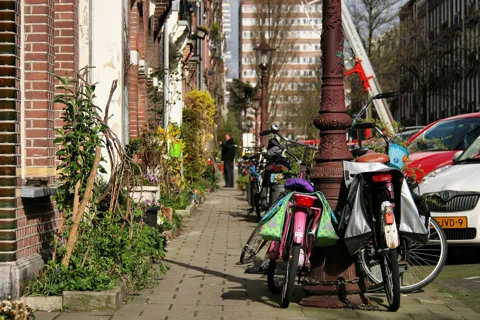
Helmersbuurt
Calm Oud-West, between Vondelpark and Foodhallen. Family-friendly, central but quiet.
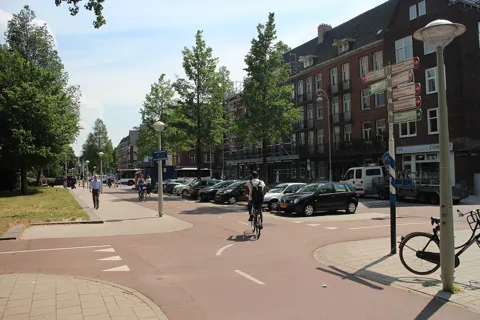
Hoofddorppleinbuurt
Quiet 1920s streets across the Schinkel from Oud-Zuid. Cheaper than its neighbours, six minutes by bike to the Vondelpark.

Indische Buurt
The station end of the Indische Buurt in Oost. Javastraat, a train station on the edge, cheaper rooms than the centre.

Jordaan
Historic working-class quarter, now bohemian. Narrow canals, brown pubs, hofjes, Lindengrachtmarkt.

Museumkwartier
Museum cluster of Amsterdam. Rijksmuseum, Van Gogh, Stedelijk, Concertgebouw. Elegant and refined.

Nieuwmarkt/Lastage
Medieval east Centrum. Waag castle, Chinatown, Zeedijk, historic merchant streets.

Oostelijk Havengebied
The former eastern docks: islands and peninsulas of 1990s housing, water on every side, and a handful of bridges in and out.

Overtoomse Sluis
Calm Oud-West along southern Vondelpark. Family-friendly, the historic lock, central but quiet.
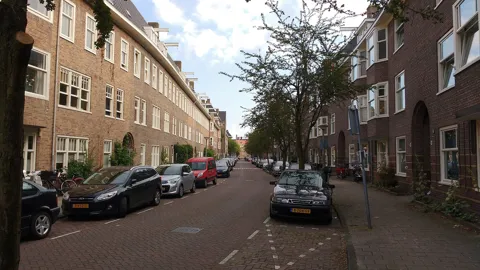
Scheldebuurt
The Rivierenbuurt end of Plan Zuid: Maasstraat and Scheldestraat for shopping, metro 52 at Europaplein, cheaper than the Apollobuurt.

Staatsliedenbuurt
Social housing and brick in Amsterdam West, ringed by water, with the Westerpark next door and the centre ten minutes by bike.

Stadionbuurt
The affordable half of Plan Zuid: small interwar flats, the Olympic Stadium, a metro station at the southern edge.

Van Lennepbuurt
Residential Oud-West between Vondelpark and Foodhallen. Family-friendly, calm, central.

Zuidas
Elegant south Amsterdam. Zuidas business district, museums, family-rich, upscale and well-connected.