

Living in Eindhoven, Netherlands
Kamer te huur van particulier Eindhoven - geen bemiddelingskosten
What you need to know before signing a huurcontract in Eindhoven - how the rental market works, the BSN tax number, registering with the gemeente at the Stadhuis, mandatory zorgverzekering, the Hermes/Bravo bus network, and how Strijp-S, Woensel, Stratum and the central buurten differ from one another.
Eindhoven isn't only Philips, PSV and Dutch Design Week. For people actually moving here, it's the Netherlands's fifth-largest city, the heart of the Brainport region - Europe's densest concentration of high-tech R&D - and a city where the buurt you pick shapes daily life. This guide pulls together what you'll want to know before signing a huurcontract, from the BSN to the Hermes/Bravo bus, and the personality of the buurten that newcomers most often consider.
The city in a few sentences
Eindhoven is the largest city of the southern Netherlands and the fifth-largest in the country, with about 250,000 people inside the municipal boundary and roughly 780,000 in the Brainport Eindhoven metropolitan region that stretches into Helmond, Veldhoven, Best and the smaller towns of the Brabant Kempen. It sits in Noord-Brabant, the southern province bordering Belgium, on the Dommel and Gender streams. Unlike the historic Dutch canal cities of the Randstad, Eindhoven is a young, modern city: a small market town until the late nineteenth century, transformed by the Philips electronics company that established its first lamp factory here in 1891 and turned Eindhoven into a company town for almost a century.
The Philips industrial heritage shapes the city visibly - the Strijp-S former production complex, redeveloped from 2002 onwards, is now the centre of the Dutch Design industry and houses the Dutch Design Week every October. The PSV football club (founded as the Philips Sport Vereniging in 1913) is the city's other defining institution. Today the city's economic engine is the high-tech ecosystem - ASML (the semiconductor lithography world leader) is based on the western edge in Veldhoven, Philips Research still operates the High Tech Campus, NXP and dozens of smaller deep-tech firms cluster across the region.
The climate is mild oceanic with grey, rainy winters that rarely freeze for long, and cool damp summers that average 21 °C. Rain is constant, falling on roughly half the days of the year. Spring is short and beautiful; autumn arrives early.
The language
Dutch is the official language. The local dialect is Brabants - a soft, melodic southern Dutch with distinctive vowels and intonation, more closely related to Flemish than to the Hollandic Dutch of Amsterdam or Rotterdam. Brabants is widely spoken, particularly by older residents, and gives the city a friendlier, less direct social tone than the Randstad - Brabanders are stereotyped within the Netherlands as warmer and more conversational.
English fluency is exceptionally high - Eindhoven is one of the most international Dutch cities, and the high-tech sector and the Eindhoven University of Technology (TU/e) run almost entirely in English. You can shop, work, see a doctor, sign contracts and live a full professional life almost entirely in English. The gemeente (municipal services) has English-language options. Learning some Dutch matters for the small social moments - and for the huurcontract, which is usually only in Dutch - but is not strictly required.
Renting a room: how it works
Eindhoven's rental market is tight but not catastrophic - easier than Amsterdam or Utrecht, harder than smaller Brabant towns. The TU/e student housing operator Vestide runs the largest pool of student rooms; international graduates often go through Vestide for their first year. The private market handles everything else: rooms in shared flats and studios circulate through general property platforms, agencies (makelaars), and Facebook groups. A significant share of long-term housing is also let through agencies, often with finder's fees that are now legally restricted.
The standard residential contract is the huurovereenkomst. Most contracts for foreigners are huurcontracten voor onbepaalde tijd (indefinite term) or tijdelijke huurcontracten (temporary, up to two years for self-contained dwellings or five years for rooms). Rent is regulated through the puntenstelsel (points system): apartments below a certain "rent value" qualify for the sociale huur (social rent) and are not available to newcomers without long Dutch residence; apartments above are in the vrije sector (free market) where rents are higher.
The waarborg (deposit) is typically one or two months' rent - there is no strict legal cap but the Huurcommissie can adjudicate disputes. Many landlords require proof of income (typically three to four times the rent), a Dutch bank account, and references. Foreign renters increasingly need an employment contract or a Dutch sponsor before being accepted, and the international community in Eindhoven is large enough that landlords are used to expatriate paperwork.
Documents: BSN, gemeente Eindhoven registration
The first administrative step is registering at the gemeente Eindhoven (the Stadhuis on the Stadhuisplein in central Eindhoven) within five days of arrival if you intend to stay more than four months. At the same appointment you receive your BSN (Burgerservicenummer), the Dutch citizen service number that is the equivalent of an Italian codice fiscale or a German Steuer-ID. Without a BSN you cannot open a Dutch bank account, sign an employment contract, register with a doctor, or get mandatory health insurance. Non-EU residents need a residence permit first, applied for at the IND (Immigratie- en Naturalisatiedienst) - the IND issues the BSN as part of the permit.
Dutch bureaucracy is digital-first. Almost every administrative action goes through the DigiD (a personal login system) on the gemeente and government portals. Activating a DigiD requires a BSN and a registered Dutch address. Eindhoven is served by the Holland Expat Center South, which combines the gemeente registration, the IND procedure and the BSN issue into a single appointment - often same-day for residents - a real advantage compared with registering through smaller Dutch municipalities.
Netherlands: what changes if you're EU or not
EU, EEA and Swiss citizens can move to the Netherlands without any visa or residence permit. The gemeente registration and the BSN are enough. If you stay over four months, you're a registered resident with full access to public services.
Non-EU citizens need a residence permit from the IND. The most common routes in Eindhoven are the highly skilled migrant (Kennismigrant) route, based on a sponsoring employer (ASML, Philips, NXP and dozens of smaller firms are recognised sponsors) and a minimum salary threshold; the orientation year (Zoekjaar) for recent graduates; the partner visa; the study visa (typically through TU/e or Fontys); and the self-employed/startup visa. The IND processes most applications in two to three months. The 30% ruling - a tax benefit for skilled migrants - is one of the main reasons Eindhoven's tech sector attracts so many international workers.
Bureaucracy here is unusually digital and efficient. Most documents are issued and renewed online via DigiD; physical visits to the gemeente are rare beyond initial registration.
Healthcare: mandatory zorgverzekering
In the Netherlands, basic health insurance is mandatory for everyone registered as a resident. Within four months of gemeente registration you must sign up with a private provider - the system is regulated but delivered through private insurers. Basic coverage is identical across insurers by law (the basispakket); they compete on additional packages, customer service, and premium. The basic premium is around 140-160 € per month (2026). Low-income residents receive a zorgtoeslag (subsidy) automatically based on their tax filing.
Coverage is comprehensive: GP visits (typically free at the huisarts you register with), specialists (after GP referral), hospital, emergency, prescriptions (with a small eigen risico deductible of around 385 € per year), maternity. Dental care for adults is excluded from basic coverage and requires aanvullende verzekering (supplementary insurance).
Choosing a huisarts (GP) within your postcode is the first practical step - Dutch healthcare is gatekeeping by design, with the huisarts referring you to specialists when needed. The main local hospital is the Catharina Ziekenhuis in Woensel (on the Michelangelolaan, east of the centre) and the Máxima Medisch Centrum group with locations in Eindhoven and Veldhoven.
Transport: Hermes/Bravo buses, the Centraal Station
Public transport in Eindhoven is run by Hermes (the regional bus operator under the Bravo fare brand for North Brabant) and NS (national rail) for trains. The city has no metro and no tram - public transit is bus-only, supplemented by high-frequency Bravodirect express lines that connect Eindhoven to Helmond, the High Tech Campus and the airport at higher frequencies and with longer-distance stop spacing.
The Bravo city buses radiate from Eindhoven Centraal across the stadsdelen. Express lines 407 and 408 run to the High Tech Campus in the south; lines 400 and 401 run the Eindhoven Airport shuttle, several times an hour. The OVpay system covers all modes; since June 2023, contactless bank cards and phone wallets work directly on the buses (tap in, tap out), and the older OV-chipkaart is being phased out. A single fare runs about a base charge plus a per-kilometre rate.
The bicycle is the defining means of transport. The flat geography, the dedicated bike lanes everywhere, and the cultural assumption that you cycle make a bike the most useful object you'll own here. Second-hand bikes are widely available from 100 €. Eindhoven Centraal is the main railway station, with direct services to Amsterdam, Rotterdam, Utrecht, Maastricht, Antwerp and Düsseldorf. Eindhoven Airport is the second-busiest in the Netherlands after Schiphol, with low-cost European connections, and is about 15-20 minutes from Centraal on the 400/401 airport bus.
Working and studying
Eindhoven and the surrounding Brainport region form the densest concentration of high-tech R&D in Europe. ASML (semiconductor lithography, the world leader) employs around 25,000 people across its Veldhoven campus and is the regional anchor. Philips Research, NXP, VDL, Signify (the lighting spin-off of Philips), and hundreds of deep-tech startups cluster across the High Tech Campus (south of the city) and Brainport Industries Campus (west). Many international companies use English as their working language, and the labour market is structured around collective agreements (cao) negotiated between employer associations and unions.
For higher education, the main institutions are the Eindhoven University of Technology (TU/e - engineering, computer science, applied physics, a tightly-coupled feeder to ASML and Philips), the Fontys Hogeschool (Fontys University of Applied Sciences, the large practice-oriented school), and the Design Academy Eindhoven (the famous post-graduate design school based in the Witte Dame building). EU/EEA students at TU/e pay statutory tuition around 2,600 € per year for bachelor's; non-EU students pay institutional tuition typically between 11,000 and 16,000 € per year. Many master's programs are taught entirely in English.
Daily life: schedules and rhythms
Eindhoven runs early by southern European standards but a bit later than Amsterdam or Rotterdam. Lunch is quick (often a sandwich at a café or eetcafé, between 12 and 1 PM). Dinner is at 6 or 7 PM - restaurants get full at this hour and most kitchens close by 9:30 or 10 PM. Bars stay open later, with the central Stratumseind (the loudest bar street in the Netherlands by some measures) running to 3-4 AM on weekends. Dutch culture is famously direct - direct, blunt, low on hierarchy and ceremony - which can register as rude to those used to French, Italian or Spanish social cushioning. In Brabant the direct culture is softened by the local warmer tone, but the bluntness remains.
Sundays still have a Dutch character: smaller shops close, but supermarkets (Albert Heijn, Jumbo) open from 10 AM to 8 PM and restaurants run normally. The Dutch year has its rhythms: Koningsdag (King's Day, 27 April) is the national holiday and turns the entire city orange. Carnaval in February-March - Brabant's Catholic festival, four days of costumes, parades and beer - is the major regional festival, distinctive to the southern Netherlands and absent in the Randstad. Dutch Design Week in October fills Strijp-S and other industrial venues with installations, talks and exhibitions, drawing 350,000 visitors. Glow in November is a city-wide light festival similar in scale to the Lyon Fête des Lumières. PSV match days at the Philips Stadion just west of the centre (in the Philipsdorp/Strijp area, by the station) shut down a chunk of the city.
Eindhoven is honest about its small-city limits: the after-dark scene outside Stratumseind and the bigger venues is genuinely thin compared with Amsterdam or Rotterdam, and people moving from larger international cities sometimes find the cultural offer modest. The flip side is that everything you need is within a 20-minute bike ride.
The buurten
Eindhoven is divided into seven stadsdelen (districts) - Centrum, Strijp, Tongelre, Stratum, Gestel, Woensel-Noord, Woensel-Zuid - each subdivided into dozens of smaller buurten. The differences are smaller than in Paris or Madrid because the city is compact, but real: redeveloped Strijp-S feels different from family-rich Woensel-Zuid, bar-loud Stratum from quiet Tongelre.
The buurt guides below cover residential Tongelre with its village core, redeveloped Strijp-S, the busy southern district of Stratum, the central Centrum with its shops and bars, the historic workers' housing of Philipsdorp, residential Gestel, the broader Strijp district around Strijp-S, the central Rochusbuurt, the elegant residential Elzent-Noord and Bergen, the small Irisbuurt, the southern residential Gennep, the working-class Looiakkers, the family-rich Woensel-Zuid to the north, and the small Joriskwartier.
Areas in Eindhoven
Each area has its own character. Read the guides to choose the right one for you.
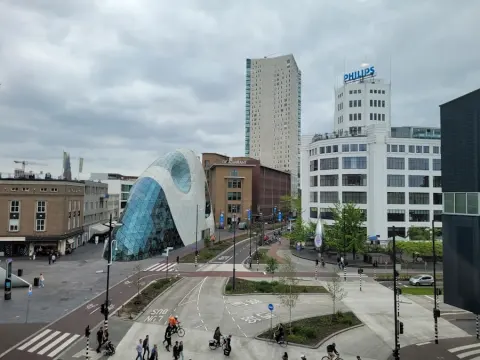
Bergen
Central. The Kleine Berg as its commercial spine, mid-rise blocks, and walking distance to Centraal.
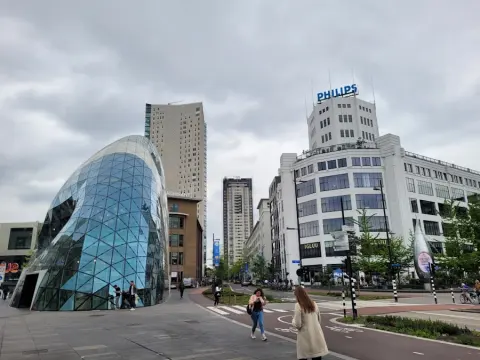
Gennep
Southern, residential, quiet. Family streets, the Genneper Parken next door.

Joriskwartier
Small, quiet, walkable. Brick row houses around the Sint-Joriskerk.
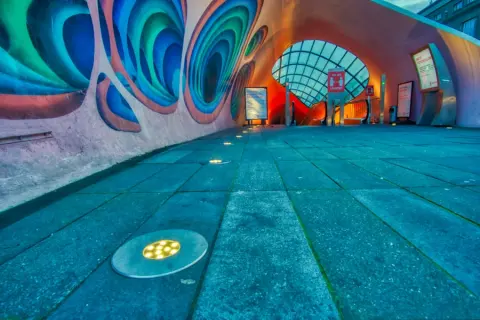
Philipsdorp
Philips workers' garden village. Brick terraces from 1910, quiet streets, walking distance to Centrum.
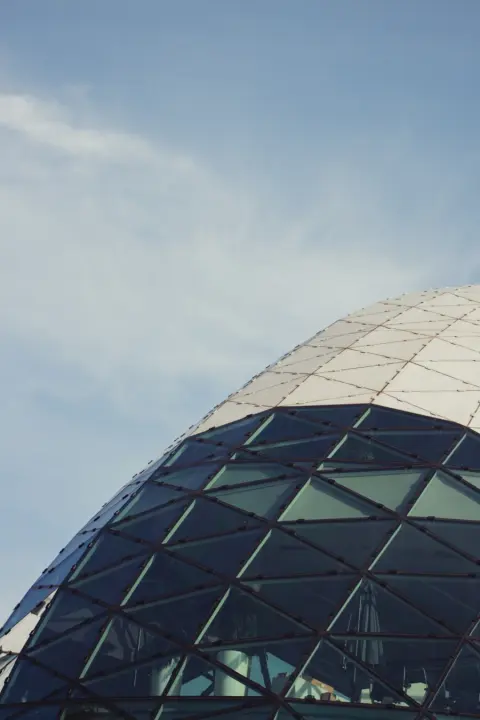
Strijp S
Dutch Design heart. Lofts in old Philips factories, the Klokgebouw, Dutch Design Week, young creative community.