
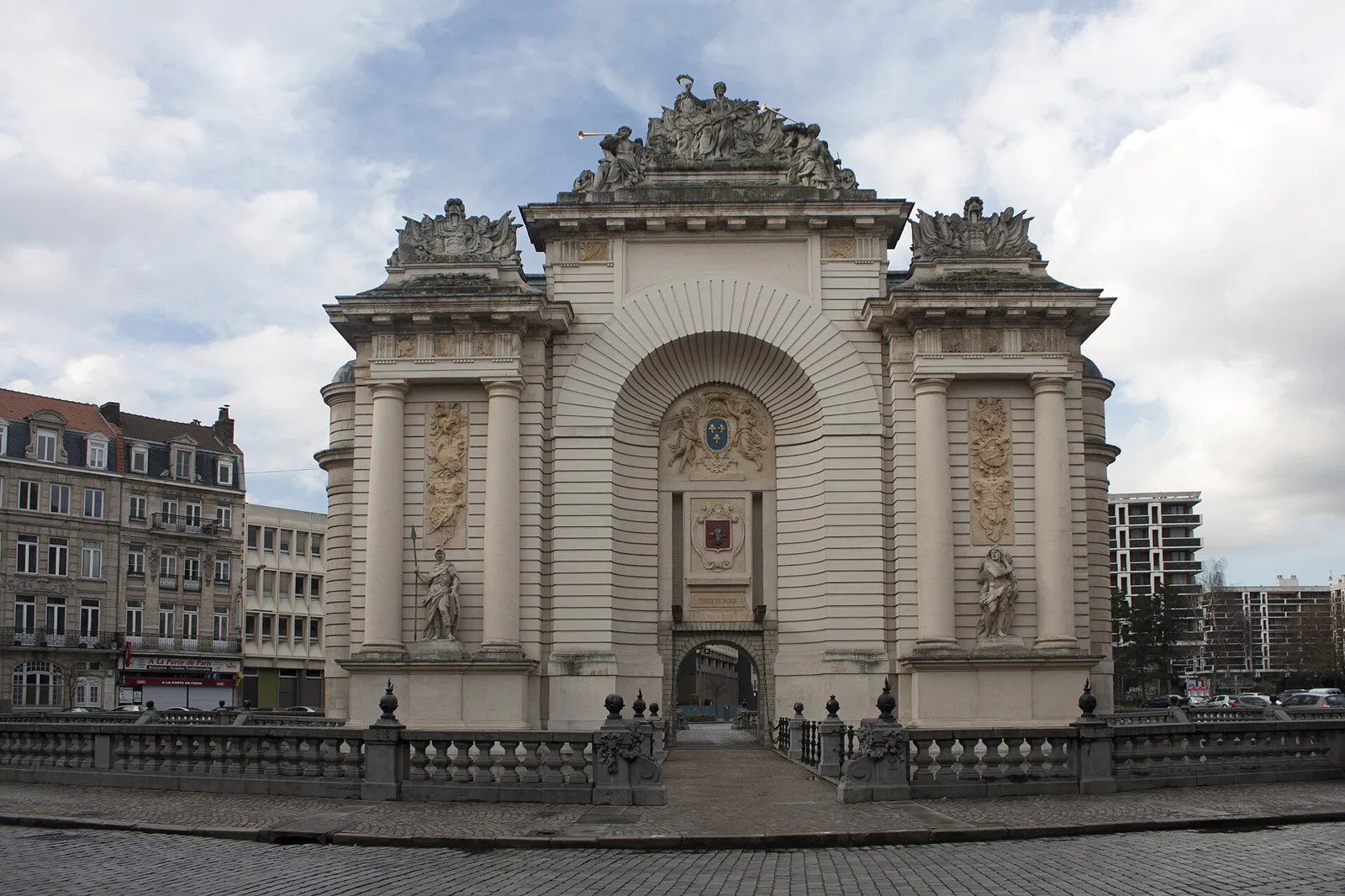
Photo: Daniel VILLAFRUELA., CC BY-SA 4.0, Wikimedia Commons
Living in Lille-Centre, Lille
Colocation Living in Lille-Centre, Lille - chambre à louer entre particuliers, sans agence - Lille
The commercial and administrative heart of Lille - the Grand Place, the Vieille Bourse, the Beffroi, the two train stations, and the densest concentration of shops, offices and restaurants in the city.
Lille-Centre is the official quartier covering the commercial, administrative and transit heart of the city - the square kilometre bounded by the Boulevard de la Liberté to the south, the Boulevard Carnot to the east, and the edges of Vieux-Lille and Vauban-Esquermes to the north and west. It is the quartier that visitors see first and that locals navigate daily.
History and identity
The Grand Place (officially Place du Général de Gaulle, after Lille's most famous son, born here in 1890) has been the city's central square since the Middle Ages. It is anchored by the Vieille Bourse - the seventeenth-century Flemish-baroque exchange building, with its inner courtyard now occupied by booksellers and chess players in fair weather - and flanked by the Théâtre du Nord (in the eighteenth-century Grande Garde building on the Grand Place itself) and the Opéra de Lille a few steps east on the Place du Théâtre. The Beffroi of the Chamber of Commerce rises behind the Grand Place; the larger and more famous Beffroi de l'Hôtel de Ville (UNESCO-listed, the tallest civic belfry in Europe at 104 metres) is a few minutes south. The Place Rihour with the surviving fifteenth-century flamboyant-Gothic fragments of the Burgundian Palais Rihour, the Place du Théâtre, and the Rue de Béthune pedestrian shopping street fill out the central core.
What to expect
Mixed-use density. Apartments above shops on every street, offices and back-office operations in the larger Haussmann-style buildings, hotels and short-stay accommodation along the Rue Faidherbe corridor. The demographic is varied - long-term residents in the older buildings, young professionals in renovated apartments, students in shared colocations near the Rue Solférino, plus a steady stream of through-traffic from the two train stations. Apartments range from charming 19th-century stuccoed buildings with high ceilings and parquet floors, to plain post-war infill blocks, to a small number of newer developments. Quality varies street by street. Storage is rare and many units lack proper natural light because of the dense block structure.
Transport
Three major métro stops are inside the quartier: Rihour (line 1, the absolute centre), Gare Lille-Flandres (lines 1 and 2, the main interchange), and Gare Lille-Europe (line 2, the international TGV station). The two train stations are 400 metres apart and together handle the heaviest passenger volume in northern France: TGV to Paris in 1h02, Brussels in 38 minutes, London via Eurostar in 1h22, regional TER trains to Roubaix, Tourcoing, Valenciennes, Dunkerque and Arras. Tram lines R and T (the Mongy historic tram) start at Gare Lille-Flandres and run north to Roubaix and Tourcoing. Buses converge on the Rue Faidherbe and the Place du Théâtre. The whole quartier is walkable end to end in 20 minutes; cycling is feasible but congested.
What to do
The Grand Place is the daily social anchor - coffee on the terrace, the booksellers in the Vieille Bourse, the Christmas market in December. The Rue de Béthune and the Rue Neuve are the commercial pedestrian spines, with the major French chains and a few local institutions. The Rue Faidherbe between the stations and the centre is the high-end shopping artery. Cinemas (the UGC Ciné Cité, the Majestic) cluster around the Rue de Béthune. Restaurants range from chain brasseries on the Grand Place to small bistros and estaminets tucked into the side streets - Aux Moules on the Rue de Béthune is a Lille institution for moules-frites. The Palais des Beaux-Arts, one of France's largest fine-arts museums outside Paris, sits on the southern edge of the quartier at Place de la République. The Opéra de Lille runs a strong programme of opera, ballet and orchestral concerts.
Best fit for
People who want the absolute centre and who use the train regularly - commuters to Paris or Brussels, frequent travellers, freelancers and professionals based in Euralille or the central business district. Lille-Centre suits anyone who values being walking distance to everything, who is happy with mixed-use density, and who accepts the trade-off of constant low-grade pedestrian and traffic noise. It is less suited to people seeking a quiet residential street with a real neighbourhood feel - the centre runs more on transit flows and commerce than on community life. Apartments facing the Grand Place, the Rue de Béthune or the station approaches will have heavy evening foot traffic and weekend crowds. Some streets feel deserted on Sundays once the shops close. Choose carefully: a block in either direction makes a real difference to noise, light and street life.