
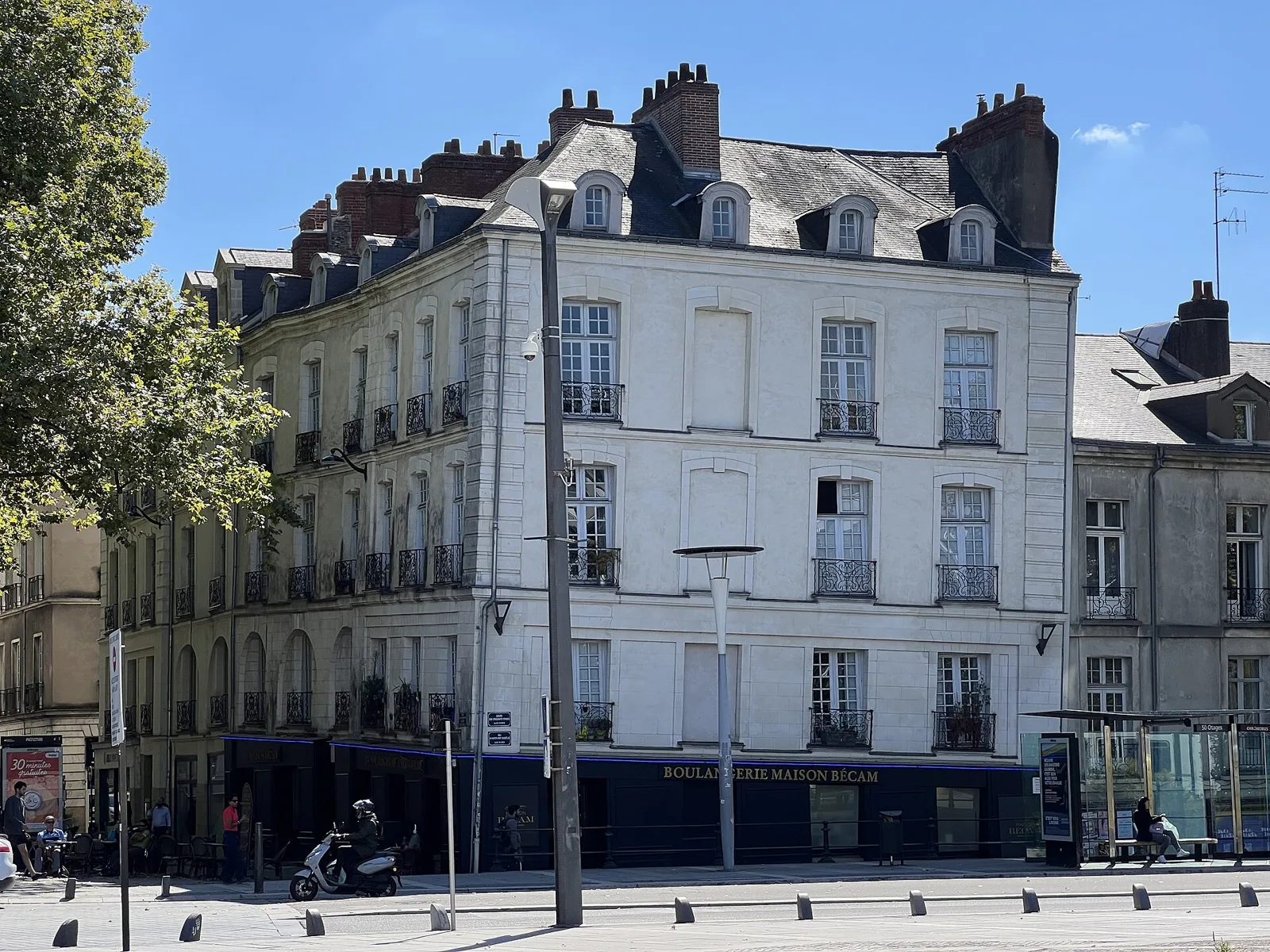
Photo: Chabe01, CC BY-SA 4.0, Wikimedia Commons
Living in Nantes, France
Colocation Nantes - chambre à louer entre particuliers, sans agence
What to know before moving to Nantes - French rental contracts and the caution, the numéro fiscal and Sécurité Sociale, the TAN tramway, and how the eleven official quartiers feel different from one another.
Nantes is the kind of move people make on purpose. The historic capital of Brittany - and now the préfecture of the Loire-Atlantique - sits 50 kilometres from the Atlantic on the lower Loire, with a climate, a douceur de vivre, and a creative-industries economy that have steadily drawn newcomers from Paris, Rennes and the wider Grand Ouest. The city has rebuilt itself twice in the last forty years: first by tearing out its docks and shipyards on the Île de Nantes, then by rebuilding them as an urban-renewal showcase with the Machines de l'Île, the Hangar à Bananes, the new courts and the École d'architecture. For people moving here, the quartier you pick really matters - Bouffay and Graslin live a different daily life from Doulon or Bellevue. This guide pulls together what you'll want to know before signing a bail.
The city in a few sentences
Nantes is the préfecture of the Loire-Atlantique and the capital of the Pays de la Loire region - though historically and culturally it is Breton, and the question of administrative reunification with Bretagne surfaces in the local press every few years. The municipality holds about 330,000 residents, the Nantes Métropole around 670,000, and the wider urban area approaches one million. It sits on the lower Loire, where the river and its arms have been spanned, channelled, partially filled-in (the northern arms of the Loire around the Île Feydeau from the late 1920s, and the bras de l'Erdre diverted and covered in the 1930s to create the cours des 50-Otages) and reshaped over the last century. The Loire meets the Sèvre Nantaise and the Erdre inside the city limits, and the Île de Nantes sits between two arms of the river south of the historic centre.
The climate is oceanic and mild. Winters rarely freeze hard - average lows around 4 °C in January - but rain is frequent year-round and skies are often grey from November to March. Summers are warm without the heatwaves of southern France, with averages of 25 °C in July and August and the occasional 32 °C spike. Spring and autumn are long. The Atlantic ocean is two hours by car at Pornic or La Baule, less by train.
Nantes is best known as the home of Jules Verne, the Machines de l'Île mechanical animals, the Folle Journée classical-music festival, and a creative economy built on architecture, design, video games, and biotech. The food scene is unpretentious - galettes, crêpes, muscadet, gros plant, Curé Nantais cheese - and the halles (Talensac, the Marché de la Petite Hollande) anchor the weekly rhythm.
The language
French is the official language and dominant in daily life. Nantes is moderately international - Nantes Université (which since 2022 has absorbed the former Université de Nantes, Centrale Nantes and the architecture and fine-arts schools), the Audencia business school, and the École des Beaux-Arts Nantes Saint-Nazaire bring large student communities - and English is increasingly accepted in central restaurants, museums, and tech and biotech offices on the Île de Nantes and around La Beaujoire. But administration is French-only: the préfecture, the CAF, the Sécurité Sociale, the EDF, your future landlord.
Even broken French transforms daily interactions: with the gardienne of your building, at the boulangerie, in the bar tabac, at the halles.
Renting a room: how it works
Nantes' rental market has tightened in the last decade as the city has grown its tech, biotech and creative sectors. Demand exceeds supply in the central quartiers (Bouffay, Graslin, Feydeau, Île de Nantes) and rooms in shared flats - colocations - circulate quickly. Main routes: classified-ad sites for full apartments, dedicated coloc sites for individual rooms, plus Facebook groupes de coloc and word of mouth.
The standard residential contract is the bail d'habitation, regulated by the Loi du 6 juillet 1989. The minimum term is three years if the landlord is an individual, six if a société civile immobilière (SCI) - but the tenant can leave at any time with one month's notice in a designated zone tendue (Nantes qualifies). Rooms in colocations can use either a single bail solidaire shared between flatmates or individual baux - the latter is usually preferable for short-to-medium-term stays.
The caution (security deposit) is regulated: one month's rent net of utilities for unfurnished places, two months for furnished. Beyond the caution, landlords usually require a garant - a guarantor, typically a parent or close relative - with French income and tax documents. For students and young workers without a French guarantor, the state-backed Visale scheme acts as a free guarantor and is widely accepted.
Most listings expect a complete dossier with payslips covering three times the rent, the last three months of bank statements, an employment contract, the previous tenancy reference, and the guarantor's complete dossier on top. Arrive prepared.
Documents: numéro fiscal, attestation de résidence
Two documents matter early. The first is the numéro fiscal - the thirteen-digit tax identifier issued automatically after your first French income tax declaration (due each May for the previous calendar year). It is required for almost everything official: the compte ameli for healthcare, the CAF, the taxe d'habitation lookup, opening some bank accounts. The first declaration is done online at impots.gouv.fr once you have an address and an INSEE numéro de Sécurité Sociale - provisional or permanent.
The second is the attestation de domicile - proof of residence. There is no equivalent to the German Anmeldung or the Spanish empadronamiento: you build proof out of bills (EDF, internet) and rental contract. Many administrative procedures require an attestation d'hébergement signed by the hébergeur (the person hosting you), with a copy of their ID and proof of their address.
France: what changes if you're EU or not
EU, EEA and Swiss citizens can move to France without any visa. There is no compulsory registration with the préfecture - your carte d'identité or passport is enough to live, work and rent. You will, however, need to register with the Sécurité Sociale, and if you want to drive long-term you'll eventually exchange or pass a French licence.
Non-EU citizens need a visa applied for at the French consulate in their country of origin. The most common routes are the visa de long séjour valant titre de séjour (VLS-TS) for students, salaried workers, the passeport talent for skilled workers, the visa visiteur for retirees and passive income, and the carte de séjour pluriannuelle. Once in France you have three months to validate the VLS-TS online at the Office français de l'immigration et de l'intégration (OFII) portal and pay the taxe de séjour. Subsequent renewals are done at the Préfecture de la Loire-Atlantique in Nantes.
Bureaucracy is precise but slow. Bring originals, photocopies, and ideally traductions assermentées for any non-French civil-status certificates.
Healthcare: Sécurité Sociale and the carte vitale
France has universal public healthcare through the Sécurité Sociale, managed by the Caisse Primaire d'Assurance Maladie (CPAM) in each department. In Nantes the relevant office is the CPAM de la Loire-Atlantique. Coverage is comprehensive: GP, specialists, hospital, emergency, prescriptions, maternity, mental health.
Registration takes weeks to months. You apply for an INSEE numéro de Sécurité Sociale by submitting a form, your ID, your birth certificate (with sworn translation if foreign), and your employment contract or proof of student status. Once registered, you receive a carte vitale - a green photo-ID card presented at every healthcare interaction and used to bill the system electronically.
Most residents also subscribe to a mutuelle - a private complementary insurance that covers what the Sécurité Sociale does not. Many employers offer a mutuelle collective as a benefit.
Transport: the TAN, the tramways, the BicloO
Nantes' public transport is run by TAN (Transports en commun de l'Agglomération Nantaise). The backbone is the tramway - three lines (T1, T2, T3) that meet at Commerce in the historic centre. T1 runs east-west from Beaujoire-Ranzay through the central stations and out to François-Mitterrand. T2 runs north-south from Orvault Grand-Val through the centre and down to Gare de Pont-Rousseau on the southern bank. T3 runs from Marcel-Paul in Saint-Herblain south through the Île de Nantes and down to Neustrie. Tram frequencies are excellent - every 4 to 6 minutes in peak hours.
Two Busway bus rapid-transit lines (C4 and C5, the latter running the length of the Île de Nantes) plus a network of Chronobus high-frequency lines and the dense local bus network fill the gaps. The whole network is integrated on a single ticket. The TAN monthly pass is around 70 € adult, with substantial reductions for under-26s and students. Single tickets are around 1.80 €.
Cycling has expanded significantly with the BicloO docked bike-share and a growing network of protected lanes. The Loire riverside quais are flat and protected - riding from the Île de Nantes to the Jardin des Plantes or out to Trentemoult on the south bank is easy and pleasant.
Nantes Atlantique airport is reached in about 20 minutes by navette shuttle bus from the Gare SNCF. The TGV connects Nantes to Paris-Montparnasse in 2 hours, to Rennes in 1h15, and to Bordeaux in 4 hours (via La Rochelle).
Working and studying
Nantes is one of the most dynamic mid-sized economies in France. The city hosts a strong digital and tech cluster (the Quartier de la Création on the Île de Nantes, the Atlanpole technopole around La Chantrerie), biotech and biomedical operations, food-processing headquarters (LU/Mondelēz, Tipiak), shipbuilding heritage at the nearby Saint-Nazaire yards, and a growing constellation of architects, designers, and video-game studios. The Île de Nantes Quartier de la Création concentrates many of the creative agencies and the École nationale supérieure d'architecture.
University tuition for public universities is among the lowest in Europe: around 175 € per year for EU bachelor's, 250 € for master's. Non-EU students pay around 2,770 € (bachelor's) or 3,770 € (master's). The main universities are Nantes Université (sciences, humanities, medicine, law), Audencia (private business school), Centrale Nantes (engineering), and the École des Beaux-Arts.
Daily life: schedules and rhythms
Nantes runs at a relaxed pace. Lunch is the main social meal of the day, eaten between 12:30 and 2 PM. Dinner starts around 7:30 to 9 PM. The food culture is rooted in Brittany - galettes of buckwheat with eggs, ham and cheese, crêpes sweet with caramel-au-beurre-salé - and washed down with local muscadet white wine and cidre.
Sundays remain quiet for shopping - most supermarkets close at 1 PM, smaller shops are shut all day, except boulangeries and central tourist zones. The Sunday-morning food markets are the social anchor: Marché de Talensac (Tuesday to Sunday morning) is the city's main covered market, Marché de la Petite Hollande on Saturday morning is the picturesque riverside option, the Marché du Bouffay on Friday and Saturday in the medieval centre.
August is the city's annual slowdown. Many restaurants close for two to four weeks. Public holidays cluster in May, July (14th), August (15th), November (1st, 11th), and around Christmas. The Voyage à Nantes summer art trail - outdoor installations along a green-line painted on the pavement - is the city's signature event, drawing visitors from June through August.
The quartiers
Nantes is divided administratively into eleven quartiers with their own mairies de quartier, plus dozens of named sub-areas with strong local identities. The differences are significant: the medieval Bouffay and neoclassical Graslin in the historic centre are dense and walkable; the Île de Nantes is the redeveloped former shipyard with the Machines and the Quartier de la Création; Bellevue - Chantenay - Sainte-Anne runs west along the Loire with a strong working-class history and a now-elevated Butte Sainte-Anne; Doulon - Bottière and Nantes Nord are more residential and varied; Nantes Erdre runs along the river of the same name and includes university and high-tech campuses.
The quartier guides below cover the medieval Bouffay heart, the neoclassical Graslin opera quarter, the elegant quais of Feydeau, the redeveloped Île de Nantes, the central préfecture district of Centre-Ville, the historic working-class Bellevue - Chantenay - Sainte-Anne, the residential Dervallières - Zola, the bourgeois-bohemian Hauts-Pavés - Saint-Félix, the modernist Breil - Barberie, the residential plateau of Nantes Nord, the river-edge Nantes Erdre, the basilica-anchored Malakoff - Saint-Donatien, and the east-side Doulon - Bottière.
Areas in Nantes
Each area has its own character. Read the guides to choose the right one for you.
Beaujoire-Halvêque
River-edge north-east. Erdre canal, Beaujoire stadium, Atlanpole technopole - leafy residential.
Boissière
Northern plateau. Petit-Port university campus, Bout-des-Landes - ongoing renewal.
Bouffay
Medieval heart. Half-timbered houses, cobblestones, Place du Bouffay - dense restaurants and bars.
Breil-Malville
North-west quartier. Le Breil grand ensemble, Barberie, La Gaudinière - ongoing renewal.

Chantenay
Working-class west bank. Butte Sainte-Anne views, Chantenay, the Jardin extraordinaire.
Dervallières
Residential western quartier. Rue Émile-Zola, Procé park, Nantes Université faculties.
Feydeau
Former Loire island. Eighteenth-century mascaron facades, Allée Turenne - unique urban geometry.
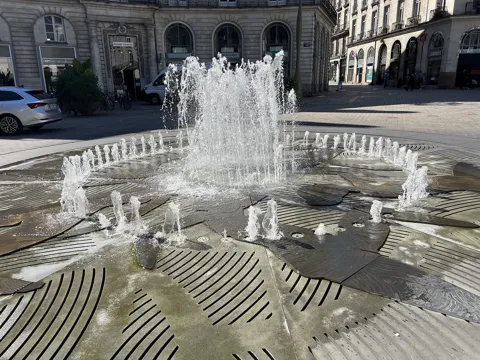
Graslin-Commerce
Neoclassical quarter. Opera, Place Graslin, Cours Cambronne - elegant haut-bourgeois apartments.
Hauts Pavés
Bourgeois-bohemian. Saint-Félix church, Talensac market, Erdre views - settled residential.
Île de Nantes
Redeveloped shipyards. Machines de l'Île, Quartier de la Création - young creative energy.
La Bottière
Eastern plateau. Doulon village, Bottière-Chénaie eco-district - ongoing renewal.

Malakoff
Eastern quartier. Saint-Donatien basilica, Malakoff renewal, Jardin des Plantes - mixed character.