
Living in Nice, France
Colocation Nice - chambre à louer entre particuliers, sans agence
What you need to know if you're moving to Nice - how French bail contracts and the caution deposit work, the garant requirement, the numéro fiscal and carte vitale, the Lignes d'Azur tram T1 and T2 and the bus network, and how Vieux Nice, Cimiez, Carré d'Or and the rest of the central quartiers really differ from one another.
Nice isn't only the Promenade des Anglais and the Baie des Anges. For people actually moving here, it's France's fifth-largest city - a Côte d'Azur capital that was Italian (the Comté de Nice, part of the Kingdom of Sardinia) until 1860, a Belle-Époque winter resort for the European aristocracy, and today a Mediterranean French city with a strong tourism economy, a research-and-tech corridor stretching west to Sophia Antipolis, and a demographic that mixes elderly French retirees, students at the Université Côte d'Azur, multicultural communities and a steady flow of international expats. The light over the Baie des Anges, the Niçois (the Nissart dialect still spoken in pockets), the socca and the salade niçoise, the Italian-French double identity - Nice is more Mediterranean and more touristified than other major French cities, and that shapes daily life. This guide pulls together what you'll want to know before signing a bail, from the garant to the carte vitale, and the personality of the central quartiers.
The city in a few sentences
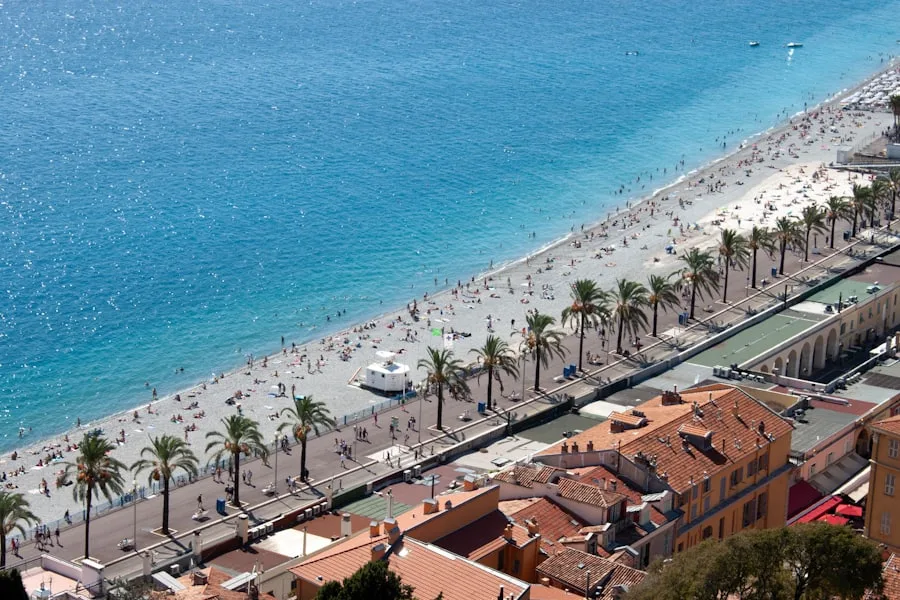
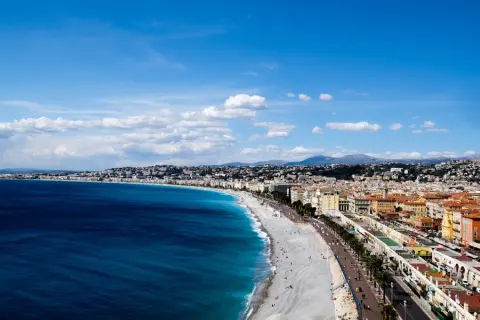
Nice is the capital of the Alpes-Maritimes department and the second-largest city of the Provence-Alpes-Côte d'Azur region (after Marseille). Population is around 357,000 inside the municipal boundary and about 1 million in the wider Métropole Nice Côte d'Azur area. The city sits on the Baie des Anges - the curved bay opening south onto the Mediterranean - between the Var river to the west and the Mont Boron hill to the east, with the Alpes-Maritimes foothills rising immediately to the north and the famous Promenade des Anglais running along the entire bay-front.
Nice has a deeply Italian history. The Comté de Nice belonged to the Duchy of Savoy and later the Kingdom of Sardinia (the same kingdom that became Italy) from 1388 until 1860, when it was ceded to France under the Treaty of Turin following a controversial plebiscite. The Italian heritage is everywhere - the old town (Vieux Nice) has a distinctly Ligurian-Italian streetscape, the local Nissart dialect is a variety of the Occitan-Ligurian language family, the cuisine (socca, pissaladière, pan bagnat) is Genoese-Provençal, and the place names (Garibaldi was born here, Place Garibaldi is named for him) carry the Italian story.
The Belle-Époque transformation began in the eighteenth century when English aristocrats discovered Nice's mild winters and started wintering here - the Promenade des Anglais takes its name from the donations and labour the English winter colony provided for the bay-front walkway in 1820. By 1900 Nice was the winter capital of European aristocracy, with the great palace hotels (the Negresco, the Westminster, the Hôtel Excelsior), the Russian Orthodox cathedral, the casinos, and a demographic of wintering Russians, English, Germans and Americans that shaped the architecture and the social tone. After 1945 mass tourism replaced aristocratic wintering, and the post-war decades transformed the city - the airport expanded, the Promenade was rebuilt, the eastern Riquier and L'Ariane social-housing estates were built, and Nice became the dense Mediterranean French city it is today.
The climate is Mediterranean at its mildest. Winters are mild - averages around 8-12 °C, rarely below freezing in the city centre - with brilliant sun and occasional rain. Summers are hot and humid - averages around 25-28 °C in July and August, with sea breezes mitigating the heat but humidity remaining high. The city averages over 300 sunny days a year. Spring and autumn are long and pleasant.
The language: French, with Nissart heritage and English in tourist zones
French is the official language and the working language of administration, banking, healthcare and most workplaces. Nissart - the local Occitan-Ligurian dialect - is still spoken by older Niçois in pockets of Vieux Nice and the older suburbs, and you'll see it on street signs and at the Festin des Cougourdons (the traditional spring festival), but you don't need it for daily life. English fluency in Nice is moderate - better than the French average because of the tourism economy and the international communities (Italian, English, Russian, American expats), but the working language in administration and most workplaces is firmly French. Italian is widely spoken - many Niçois have Italian family ties and the cross-border traffic with Ventimiglia (just over the border) is constant. Basic French is necessary for the bail and for dealing with the propriétaire.
Renting a room: how it works
Nice's rental market is tight - tighter than Marseille, looser than Paris. The combination of student demand from the Université Côte d'Azur, the strong tourism economy that pulls housing stock into short-term holiday lets, the elderly French Riviera retiree demographic, and the international community has pushed up prices significantly. The search happens almost entirely online - on the main flat-share (colocation) platforms and classified-ad sites for rooms, on the national property portals for whole apartments, and in Facebook groups for students and newcomers. Many landlords use agences immobilières which charge a fee at the start of the lease (regulated by law).
The standard contract is the bail, normally for three years if the landlord is a private individual, six years if the landlord is a corporate entity. A bail meublé (furnished lease) is shorter - one year, or nine months for students. The deposit (caution or dépôt de garantie) is capped by law: one month of rent for unfurnished, two months for furnished. Refundable at the end of the lease minus deductions for damage.
The big French specificity is the garant - a guarantor, usually a parent or a French resident with a salary at least three times the rent, who signs to cover unpaid rent. Without a garant most private landlords will refuse the dossier. Public alternatives exist: Visale, the free state guarantee for young people up to 30 and for low-income workers, is widely accepted in Nice. Bank guarantees and cautionnement bancaire are alternatives but more expensive.
The dossier is the file you submit with your application: passport or ID, last three pay slips (bulletins de salaire) or student card, last avis d'imposition (tax notice), a RIB (bank details), the garant's dossier on the same model. A complete dossier wins the apartment in the tight Nice market - landlords often have five or ten dossiers to choose from.
The numéro fiscal: the first administrative step
You don't have a single mandatory registration step like the German Anmeldung, but a few documents matter from day one. The numéro fiscal is your French tax number; you'll need it for almost any administrative procedure (opening a bank account, registering for the carte vitale, paying tax). It's assigned the first time you file taxes (déclaration de revenus) or when you contact the Service des Impôts des Particuliers directly. Most expats get it within a few months of arrival.
The numéro INSEE (the numéro de sécurité sociale, your social security number) is needed for the carte vitale. You apply at your local CPAM (Caisse Primaire d'Assurance Maladie). For titre de séjour (residence permit, non-EU) you'll go to the préfecture of the Alpes-Maritimes.
France: EU and non-EU
EU passport holders can live and work in France without a residence permit. The first administrative step is opening a bank account and getting the numéro fiscal - neither is strictly mandatory but both are needed for daily life. From outside the EU, you need a titre de séjour to stay beyond ninety days, granted by the préfecture. Common categories: salaried work (salarié), student (étudiant), passeport talent for qualified workers and researchers, visiteur for non-working long-stay (e.g. retirees), family reunification.
French bureaucracy is paperwork-heavy and slow. Every document must be in French or accompanied by a certified translation. Plan three to six months for the titre de séjour renewal cycle.
Healthcare: CPAM and the carte vitale
Health insurance is mandatory through the PUMa (Protection Universelle Maladie) - everyone legally resident in France is covered after three months. You register at the CPAM with proof of address, identity and residence; the carte vitale (the green plastic card) arrives by post a few weeks later. The state pays most of the cost of GP visits, specialists, hospital and prescriptions; the rest is covered by mutuelle (complementary health insurance, often through employers).
The system works well for routine medicine and emergencies. The Nice public hospital system is anchored by the Centre Hospitalier Universitaire de Nice with the Hôpital Pasteur and the Hôpital de l'Archet as the main facilities, plus the Hôpital Saint-Roch in the centre. Waiting times for non-urgent specialists in Nice can be weeks. EU students use the EHIC during their initial months.
Transport: Lignes d'Azur, tram T1/T2/T3, buses
Local transport is run by Lignes d'Azur, the Métropole Nice Côte d'Azur transport authority. The system has three main components.
The tram is the backbone. Line T1 (red) runs north-south from Henri Sappia (the former Las Planas terminus, renamed in 2013) in the north through Comte de Falicon, Libération, Jean Médecin, Place Masséna, Garibaldi and the Vieux Nice edge, then east through Le Port and Riquier to Hôpital Pasteur. Line T2 (blue) is the airport line - it runs east-west from CADAM (the city's administrative complex in the west) and the Aéroport Nice Côte d'Azur (Terminals 1 and 2) along the western bay-front through Magnan and Grand Arénas to Jean Médecin, then runs underground beneath the centre to Garibaldi and Port Lympia; it connects the airport to the city centre in roughly 30 minutes. Line T3 (green) branches off the T2 alignment near Gare de Nice-Saint-Augustin and runs north-west to Saint-Isidore, serving the Allianz Riviera stadium.
The bus network fills the gaps - Lignes d'Azur runs over 100 lines covering the Métropole. The Bus de Nuit covers limited night service.
Fares are integrated. A single ticket (billet unitaire) is around 1.50 €. The monthly pass (pass mensuel) is around 40 € for adults; students under 26 pay around 23 € with the Pass Jeune. Tickets are bought at machines, at tabacs, or via the Lignes d'Azur app.
Cycling has improved with the Vélo Bleu docked bike share and the Promenade des Anglais cycle lane - Nice is largely flat in the centre and the bay-front cycling is excellent. Trottinettes électriques (e-scooters) have a complicated history with frequent regulation changes.
The Aéroport Nice Côte d'Azur is France's second-busiest airport after Paris - accessible by tram T2 in about 30 minutes, by airport bus (line 12) or by taxi. The Gare de Nice-Ville (the main train station) connects Nice to Paris (TGV in 6 hours), Marseille, Italy (Ventimiglia, Genoa) and the Côte d'Azur coastal cities (Cannes, Monaco, Menton).
Working and studying
Nice's economy is anchored by tourism (the city is one of Europe's largest tourist destinations), the Sophia Antipolis technology park (15 km west, the largest tech-research park in France with major Amadeus, Hewlett Packard Enterprise, Orange and INRIA facilities), public sector (the Métropole and the Conseil Régional employ thousands), healthcare (the CHU de Nice), and a growing services-and-finance sector. The aerospace sector (with Thales Alenia Space at Cannes-La Bocca, just west) adds another major employer.
The Université Côte d'Azur (UCA) is the main university - a merged institution formed in 2020 by combining the previous Université de Nice Sophia Antipolis and several grandes écoles, with around 35,000 students across multiple campuses (the main Valrose campus in northern Nice, the Saint-Jean d'Angély campus in central Nice, the Carlone humanities campus, the Faculté de Droit downtown, and the Sophia Antipolis science-and-engineering campus). The EDHEC Business School has its main campus in Nice. Tuition for EU citizens is symbolic (around 175 € a year for licence, 250 € for master); non-EU citizens pay more (around 2,770 € for licence).
Daily life: socca, the bay-front, the elderly demographic
Nice has its own daily rhythms shaped by the climate, the tourism economy and the demographic. Shop hours run looser than in Germany. Most supermarkets open until 8 or 9 PM, some until midnight (Carrefour City, Franprix). Sundays vary - some supermarkets open in the morning, most bakeries open every day, larger shops are closed by law. The halles and food markets (the Cours Saleya market in Vieux Nice is the major one) run mostly in the morning.
Nice drinks pastis (Provençal anise apéritif) and the local Côte d'Azur wines, eats socca (the chickpea-flour pancake cooked on a wood-fired oven, the Nice street-food signature), pissaladière (the local onion-and-anchovy flatbread), salade niçoise (in its real form, with tuna, anchovies, eggs, tomatoes, olives - no boiled vegetables, contrary to many international versions), pan bagnat (the salade niçoise turned into a sandwich), and the wider Provençal-Italian cuisine (olive oil, tomatoes, garlic, anchovies, basil, rosé wine). The historic Chez Pipo on rue Bavastro (near the port) is the most famous socca address; the Cours Saleya market handles the daily food shopping.
Nice has a particular demographic challenge: an elderly French Riviera retiree population that gives the city a distinctive social tone. The Côte d'Azur has been France's retirement coast for over a century, and Nice has one of the highest median ages of any major French city. This shapes the social rhythms - early dinners, conservative urban politics, quiet evenings outside the tourist zones - and is something newcomers from younger French cities (Marseille, Lyon) sometimes find surprising. The summer tourist saturation is the other defining feature: from June to September the population doubles, the Promenade is crowded, restaurants triple their prices, and many residents leave for the inland villages.
Football matters but less than in Marseille - OGC Nice plays at the Allianz Riviera stadium (in the north-west of the city, accessible by tram T3) and has a strong local following. The Carnaval de Nice in February is the major annual event; the Nice Jazz Festival in July is another. The Côte d'Azur offers immediate weekend escapes - Monaco (20 minutes by train), Menton (40 minutes), Cannes (30 minutes), Antibes (25 minutes), and the inland villages of Saint-Paul de Vence, Vence and Mougins.
The neighborhoods (quartiers)
Nice is officially divided into nine cantons and dozens of named quartiers - what matters locally is the quartier, the named local neighborhood. The bay-front strip running from Vieux Nice in the east to Carras in the west, the hilltop Cimiez and the inland hill quartiers north of Libération, and the eastern Riquier-and-Port area each carry distinct identities.
There's the green-and-residential Parc Impérial; the central-and-hospital-adjacent Carabacel; the medieval Italian Vieux Nice; the working-class La Madeleine; the bourgeois bay-front La Buffa; the local high-street Borriglione; the rail-and-civic Thiers; the bourgeois belle-époque Cimiez; the residential Le Piol; the small inland Mantega; the Belle-Époque composer-streets Musiciens; the luxury Carré d'Or; the residential Pessicart; the busy market hub Libération; and the northern residential Saint-Maurice.
The neighborhood guides below go into detail: who lives there, what days and evenings are like, what's within tram and bus reach, and when you might want to pick somewhere else.
Areas in Nice
Each area has its own character. Read the guides to choose the right one for you.

Borriglione
Nice's local high-street quartier north of Thiers and Libération - small commercial avenues, the Marché de la Libération immediately south, traditional French brasseries, settled long-term Niçois residents, and tram T1 connections to the centre.
Carré d'Or
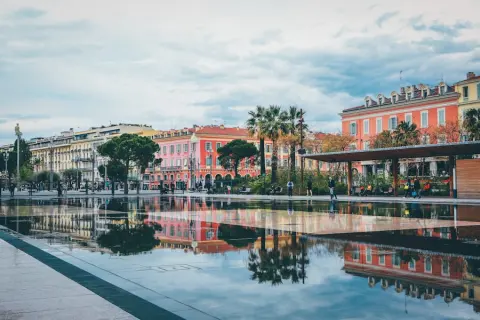
Nice's luxury central quartier between the Promenade des Anglais and Place Masséna - densest luxury shopping in the city on rue Paradis and avenue de Suède, historic palace hotels, exclusive Belle-Époque residential blocks, and the most prestigious central postcode.

Cimiez
Nice's bourgeois hillside quartier - Belle-Époque palaces, Roman amphitheatre at the Site Archéologique, Musée Matisse in a seventeenth-century Genoese villa, Monastère de Cimiez, and a settled elegant identity preferred by Nice's old families and senior expats.
La Madeleine
Nice's working-class western quartier on the Var corridor - the Hôpital de l'Archet, the Madeleine church, Maghrebi-Italian immigrant community, Avenue de la Lanterne commercial spine, and modest rents.

Libération
Nice's busy market-hub quartier on the avenue Malausséna corridor - the major Marché de la Libération daily food market, Église du Vœu, tram T1 Libération stop, strong local high-street identity, and one of the most authentic local quartiers in central Nice.

Saint-Maurice
Nice's northern residential quartier on the lower slopes of Mont Gros - modest post-war apartment buildings, the historic Église Saint-Maurice, the Mont Gros observatory, settled local identity, and tram T1 connections south to Libération and the centre.
Thiers - Musiciens
Nice's Belle-Époque central quartier of composer-named streets - Place Mozart, grand palais mansions, the Gare de Nice-Ville on the northern edge, the Basilique Notre-Dame nearby, elegant residential blocks, and a settled central identity between Carré d'Or and Les Baumettes.

Vieux Nice
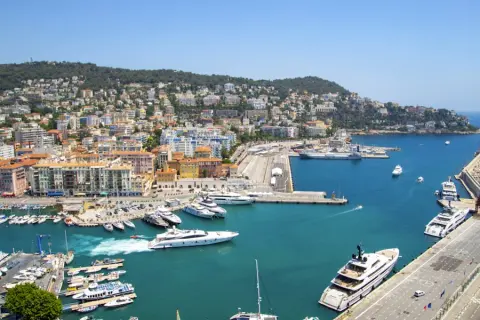
Nice's medieval Italian old town - narrow Ligurian streets between Place Masséna and the Colline du Château, the daily Cours Saleya flower-and-food market, the Palais Lascaris baroque palace, the Cathédrale Sainte-Réparate, socca counters, and the densest tourist-and-nightlife centre.