Living in Wrocław, Poland
Pokój do wynajęcia od właściciela Wrocław - bez pośredników
What to know before moving to Wrocław - how the umowa najmu works, the PESEL number, NFZ public healthcare, the MPK tram and bus system, and how to navigate Stare Miasto, Nadodrze, Krzyki and the rest of one of Poland's biggest cities.
Wrocław is one of Poland's biggest cities, the capital of Dolny Śl� sk (Lower Silesia), and one of the country's most layered and pretty places. Built on a dozen islands at the meeting of the Odra river and its tributaries, with more than a hundred bridges, it's often called the "Venice of the North" - a marketing slogan that turns out to be partly true. It's also a tech and business hub, a university town with around 130,000 students, and a city that has been Polish, Bohemian, Austrian, Prussian, German and Polish again over the past thousand years. This guide covers what you'll want to know before signing a umowa najmu, from the PESEL to the MPK monthly card, and from the medieval Rynek to the residential districts on the city's edges.
The city in a few sentences
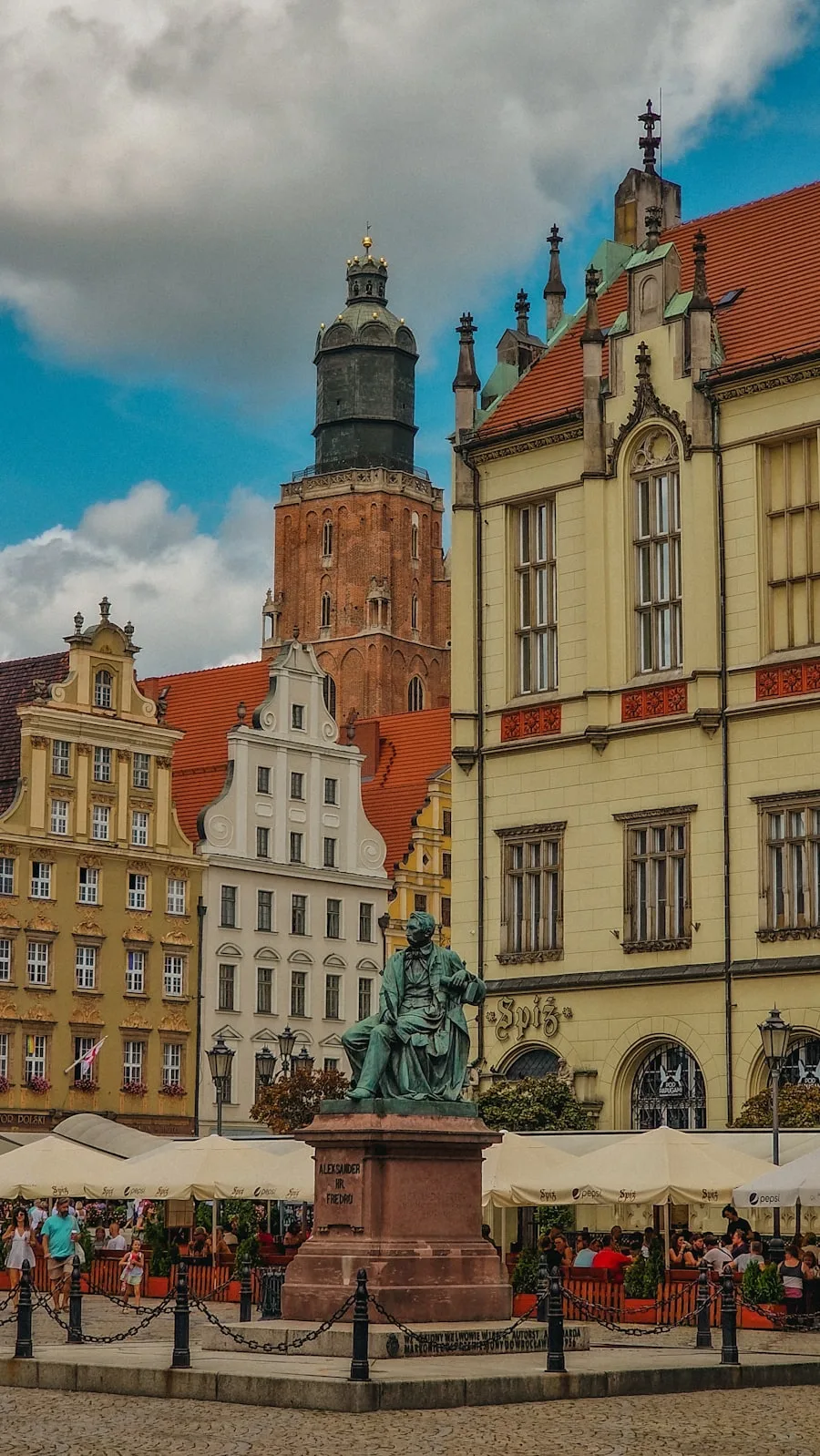
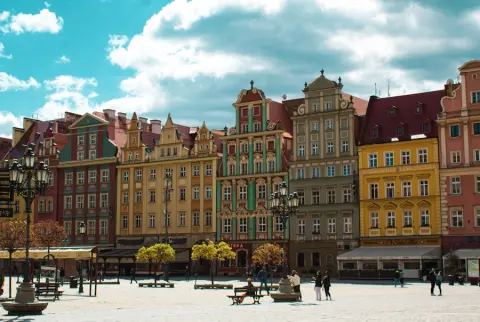
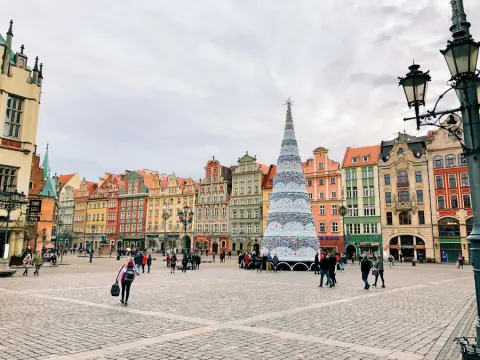
Wrocław is the largest city in southwestern Poland, with around 675,000 inhabitants in the municipality and roughly 1.25 million in the wider metropolitan area. It sits at the geographic and historical heart of Lower Silesia, with the river Odra running through the middle of the city and spreading into the network of channels, islands and bridges that defines its character. The historic center is one of the largest market squares in Europe - the Rynek, a vast rectangle of roughly 213 by 178 metres, with the late-Gothic Ratusz (town hall) at its center.
The city's history is unusual even by Central European standards. Founded as a Polish settlement around the year 1000, it spent centuries under Bohemian and then Habsburg rule, became Prussian and then German after the 18th century, was almost completely destroyed in 1945 as the German fortress city of Breslau, and was repopulated after the war primarily by Poles who had been displaced from the eastern Kresy territories - most famously from Lwów (now Lviv in Ukraine), whose famous Ossolineum library was moved here. That layered history is visible in the surviving Gothic churches, the rebuilt baroque townhouses, the 19th-century German tenement blocks and the post-war communist housing estates that ring the inner city.
The climate is properly continental. Winters are long and grey, with temperatures often around or below freezing from December to March, frequent overcast skies, and the now-notorious smog from coal heating that hangs over the city on cold windless days. Spring and autumn are short. Summers are warm and pleasant, with stretches in the high 20s and 30s, and the city lives outside until late on the riverbanks and in the Rynek. The dwarves - the small bronze sculptures of Krasnale scattered through the streets - are a Wrocław icon, and tourists hunt them with little maps.
The language: Polish, with high English among the young
Polish is the only official language, and you'll need at least the basics for daily admin - a kawa, proszę at the counter, reading a lease, talking to an older landlord or Pani z urzędu. That said, Wrocław is among the most English-friendly cities in Poland. The student population is large and internationally mixed, the tech industry operates almost entirely in English, and anyone under 35 working in a city-center café, hotel, restaurant or office is likely to be comfortable in English.
Where you'll feel the gap: with older residents, at the urz� d skarbowy (tax office), at NFZ, in any encounter that touches state bureaucracy, and at the neighborhood level - the grocer on the corner, the dry cleaner, the Pani who runs the building. A few weeks of basic Polish help disproportionately, and the Erasmus Student Network and various university programs offer free or cheap courses.
Renting a room: how it works
Wrocław's rental market is tight, with pressure from the student intake every September and from the steady inflow of tech and business professionals. Demand is strongest in the central districts (Stare Miasto, Śródmieście, Plac Grunwaldzki, Krzyki) and finding a pokój (room in a shared flat) takes patience and a quick reply. Landlords often expect you to be ready to view within a day and decide on the spot.
The standard Polish rental contract is the umowa najmu. It can be open-ended (na czas nieokreślony) or for a fixed term (na czas określony), and a stricter sub-type - the najem okazjonalny - gives landlords stronger eviction rights and is increasingly common for private rentals. Read carefully which type you're being offered. The kaucja (security deposit) is typically one month's rent, occasionally two or three, and is legally refundable at the end of the contract if there's no damage; in practice, getting it back can take negotiation.
When you read a listing, the price usually breaks into the czynsz najmu (rent paid to the landlord) and the opłaty administracyjne or czynsz administracyjny (building fees paid to the housing co-op or wspólnota, covering common areas, water, sometimes heating). Utilities (electricity, gas, internet) are normally on top. Always ask what's included before signing. Students often rely on the university's Biuro Karier and informal Facebook groups; international workers tend to use English-language listings through their employer's relocation channel.
The PESEL: your Polish identity number
The PESEL is an eleven-digit national identification number, and you'll need it for almost everything: opening a Polish bank account properly, registering for NFZ healthcare, signing an employment contract, dealing with any government office. EU citizens can request it after registering their stay (zameldowanie) at the local urz� d dzielnicy - in Wrocław, that's typically the Urz� d Miejski Wrocławia. Non-EU residents typically receive it as part of their residence card application. There's also a route to request a PESEL for tax purposes (PESEL dla celów podatkowych) that's faster but more limited.
For the zameldowanie - the formal registration of your address - you'll need a signed declaration from the landlord that you live at the property, your passport or national ID, and the standard form. It's not always required for short-term stays but it's the foundation for getting your PESEL quickly.
Poland: what changes if you're EU or non-EU
EU/EEA/Swiss citizens can live and work in Poland without any residence permit. If you stay beyond three months you should register your stay at the Urz� d Wojewódzki Dolnośl� ski on plac Powstańców Warszawy and receive a registration certificate, but the right to be here doesn't depend on it.
Non-EU citizens need a visa to enter and a karta pobytu (residence card) to stay beyond 90 days. The most common routes are work-based (with the zezwolenie na pracę, often attached to a specific employer), study-based, family reunification, and the Polish Blue Card for highly qualified workers. Processing times at the Urz� d Wojewódzki can be slow - months, occasionally over a year for complex cases. Prepare every document carefully; missing translations or unsigned forms cost weeks.
NFZ: public healthcare
Poland's public health system is run by the Narodowy Fundusz Zdrowia (NFZ). If you're employed in Poland with a formal contract, your employer enrolls you automatically and a fixed percentage of your gross salary funds your coverage. EU citizens visiting can use the EHIC of their home country for urgent care. Self-employed residents can join NFZ voluntarily, paying monthly contributions.
In practice, NFZ covers GP visits, specialist referrals, hospital care, prescriptions at reduced cost, mental health support. The downside is waiting times: for a non-urgent specialist, it can be months. Many Wrocław residents complement NFZ with a private package - Medicover, LUX MED, Enel-Med are the big three - often through their employer as a benefit. The private offer gets you specialist appointments within days, English-speaking doctors, and modern clinics.
Transport: MPK trams and buses
Public transport in Wrocław is run by MPK Wrocław and is built around an extensive tram network - over thirty lines running through every quarter of the inner and middle city - plus a comprehensive bus network and a few suburban rail lines. There is no metro: the geology under the Odra and the relatively small footprint of the inner city mean a metro has never been built. The trams are the spine of daily commuting. Lines like tram 9, which runs east past Plac Grunwaldzki toward Sępolno and the Park Szczytnicki area, and the recently extended western routes to Nowy Dwór cover almost any destination inside the city.
The standard ticket option for residents is the Urbancard monthly pass, valid on all MPK trams and buses within the city. Shorter passes (24 hours, 72 hours, weekend) and single tickets are available through the MPK app, ticket machines and onboard validators. Polregio and Koleje Dolnośl� skie commuter trains serve the wider region. The main railway station, Wrocław Główny, is a beautifully restored neo-Gothic building south of the inner city. Cycling is popular and the city is flat; a public bike system covers the inner districts in spring through autumn.
Working and studying
Wrocław is one of Poland's strongest secondary economies, with a particularly large presence in business services, IT and software development, automotive and aerospace engineering, and manufacturing. The Wrocławski Park Technologiczny and the corporate offices around the railway station and Sky Tower host hundreds of multinationals - Google, Nokia, Credit Suisse, IBM, Capgemini, HP, Volvo and many others have significant operations. The tech and business-services scene operates largely in English, and English-language job postings are easy to find.
For higher education, the city has a long student tradition. The Uniwersytet Wrocławski (University of Wrocław) is the oldest, with strong humanities, law, science and medical faculties. The Politechnika Wrocławska (Wrocław University of Science and Technology) is one of Poland's top engineering schools. The SWPS Uniwersytet, the Akademia Sztuk Pięknych, the Uniwersytet Medyczny and the private business school WSB round out the main institutions. EU/EEA students study free in Polish-taught programs; non-EU students pay tuition that varies by program. Many master's programs are taught in English.
Daily life
Wrocław's daily rhythm runs late by Northern European standards. Workdays start around 8 or 9, lunch is often grabbed at a bar mleczny (subsidized milk bar) or a casual lunch spot, and dinners in the Rynek and along the Pasaż Niepolda run from 7 PM until late. The food scene is good and getting better - pierogi in their many regional variants are a city staple, with pierogi ruskie (potato and farmer's cheese), meat, mushroom and seasonal fruit fillings; zapiekanki, kebab, modern Polish kitchens and an international scene of Ukrainian, Vietnamese, Italian and Middle Eastern restaurants all thrive.
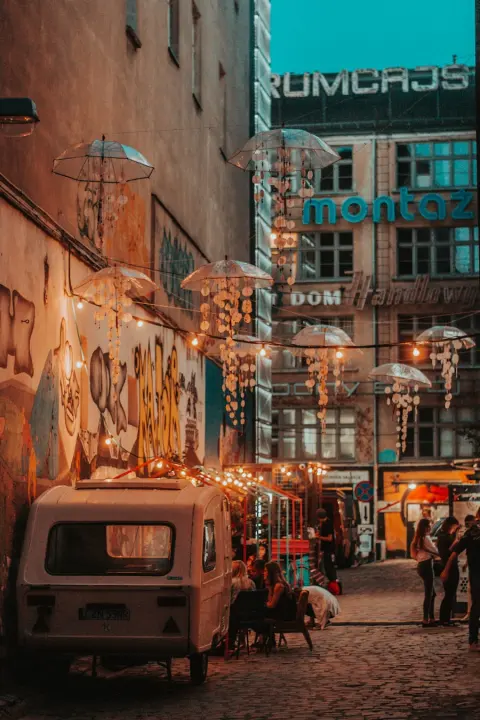
The Krasnale - the small bronze dwarf sculptures scattered through the streets, more than a thousand of them at last count - are a city icon. They started as a tribute to the anti-communist Pomarańczowa Alternatywa (Orange Alternative) movement of the 1980s and have become a tourist hunt with maps. The Old Town concert and cultural calendar is dense, with the Hala Stulecia (Centennial Hall, a UNESCO site east of the center) hosting major events, and the Narodowe Forum Muzyki on plac Wolności running a year-round program. Summer evenings on the Odra riverbanks, with the Wyspa Słodowa (Malt Island) and Wyspa Bielarska drawing student crowds, are one of the city's defining experiences.
It's worth being honest about the city's two main weather-related problems. Winter air quality is poor: the smog from Silesian coal heating produces some of the worst urban air in Europe on cold windless days, and locals routinely check air-quality apps from October to March. The flooding history is real too - the great 1997 powódź tysi� clecia (flood of the millennium) and the 2010 flood both caused significant damage, though the city's flood-defense system has been heavily upgraded since.
The neighborhoods
Wrocław's character changes sharply from one district to the next. The fifteen neighborhood guides below cover the historic core and a band of inner districts that are realistic for newcomers looking for a room.
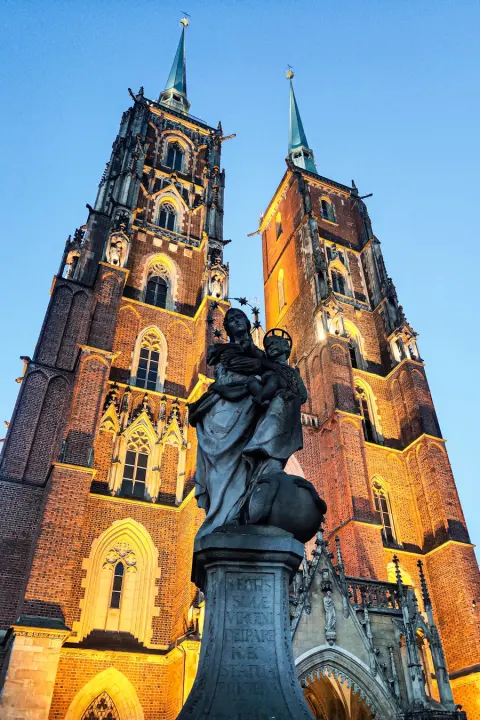
There's the cathedral island of Ostrów Tumski at the city's symbolic spiritual center, the adjacent canonical district of Ostrów Tumski we Wrocławiu, and the gently gentrifying former working-class area of Nadodrze. The southern outer-ring inner districts of Przedmieście Świdnickie and Powstańców Śl� skich lie just south of the Old Town, with the rapidly redeveloping commercial-and-residential corridor of Szczepin to the west. North of the river sits Ołbin, and at the symbolic heart of the city the medieval old town of Stare Miasto with its enormous Rynek market square. The unusual religious district of Dzielnica Czterech Wyznań (Four Faiths District) brings a churches-and-synagogue corner of the inner city, and across the water Przedmieście Oławskie is the next district up for redevelopment. West of the center, Popowice and Gajowice cover the post-war residential ring; east, Plac Grunwaldzki anchors the student and academic district around the universities. The triangle of Trójk� t sits in the inner-city mix, and the working-class Huby on the south side rounds out the band.
Each guide that follows covers who lives there, what the days and evenings feel like, how the transport connects, and when the area might not be your best choice.
Areas in Wrocław
Each area has its own character. Read the guides to choose the right one for you.

Gajowice
A southwestern inner district mixing post-war housing estates with surviving 19th-century tenements.

G� dów
A large post-war housing estate west of the center, with mid-rise blocks and planned green spaces.
Huby
A working-class southern district of 19th-century tenement blocks and post-war housing, with the main railway station nearby.

Nadodrze
A gently gentrifying inner-north district of restored tenements, craft studios and one of the city's strongest design scenes.

Ołbin
A mixed inner-north district of 19th-century tenements and post-war blocks, calmer than nearby Nadodrze.
Plac Grunwaldzki
The student district east of the center, with the main university campuses and modern residential towers.
Przedmieście Oławskie
A southeastern inner district of 19th-century tenement blocks being slowly redeveloped, with the river Odra at its edge.
Przedmieście Świdnickie
A southwestern inner district of 19th-century tenement blocks south of the Old Town, with the Świdnicka boulevard at its spine.

Stare Miasto
The medieval Old Town with the enormous Rynek market square, the Gothic Ratusz and centuries of layered history.