
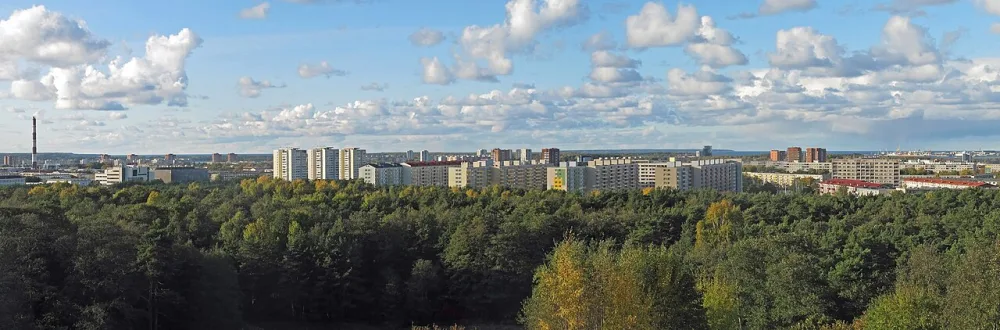
Photo Wikimedia Commons
Living in Mustamäe, Tallinn
Tuba üürile Living in Mustamäe, Tallinn - otse omanikult, vahendustasuta - Tallinn
Tallinn's first large-scale Soviet housing district, built from the late 1950s on the south-western edge of the city. Around sixty-five thousand residents, three hundred prefabricated apartment blocks among pine trees, and the Tallinn University of Technology campus at its heart.
Mustamäe - literally "the black hill" - is the south-western linnaosa (district) of Tallinn, the first of the Soviet-era mass housing estates and still one of the largest residential areas in the country. Construction began in 1962 on what had been forest and quarry land; by the early 1970s around eighty thousand people lived here, attracted partly by the relocation of the Tallinn University of Technology to the district. Today the population is closer to sixty-five thousand, and the standalone houses of the original villages have long since vanished under the panel blocks.
Who lives here
The mix is unusually flat for Tallinn. A large share of residents bought their flats during the early-1990s Soviet-housing privatisation and never moved out, so you have a stable pensioner population that has been here for fifty years. Around them is a steady inflow of students and staff from Taltech and from the North-Estonia Medical Centre at Mustamäe's northern edge, plus young families who want a three-room flat for the price of a one-room in Kalamaja. Ethnically the district is mixed Estonian and Russian-speaking, with the Russian-speaking share rising as you move east toward Sõpruse puiestee.
What it's like during the day
Daylight Mustamäe is calmer than its scale suggests. The blocks are arranged in microdistricts of three to ten buildings around shared courtyards, with playgrounds, kindergartens and small shops at ground level. The main spine Sõpruse puiestee runs north-south through the district and carries most of the commercial activity: the Mustamäe Keskus mall, a regular Maxima, the Mustika shopping centre on the southern edge, plus the medical campus at the top. Between the blocks, mature pine and birch - the original forest - survives in significant patches, and the central Männi park is one of the larger green spaces inside the ring of suburbs.
What it's like in the evening
Mustamäe is residential after dark - people are home, lights on, very few bars or restaurants outside the malls. The university campus around Akadeemia tee keeps a low background of student life, with a couple of cafés and the TalTech library open late during term, but for a serious night out residents take a tram or bus down to Kesklinn or Telliskivi. What you get in exchange is silence and dark sky: the courtyards between the blocks are remarkably quiet for a district this size, and the surrounding forest reaches the windows of the outermost buildings.
Getting around
Mustamäe is well-served but not by tram - the tram network does not reach this far west. Instead, frequent buses and trolleybuses run along Sõpruse puiestee, Ehitajate tee and Mustamäe tee, connecting in fifteen to twenty minutes to Kesklinn and Vabaduse väljak. By car the district links straight onto the E263 / Pärnu maantee and the western ring. Bike paths are mostly along the main avenues, less developed inside the microdistricts. The new Tallinn tram line 4 extension discussion has been on and off for a decade.
Eating and shopping
Day-to-day shopping is more than covered: Mustamäe Keskus (Rimi, pharmacies, post office), Mustika (Selver hypermarket), the Maxima XX at Sõpruse and Säästumarket scattered through the microdistricts. The Akadeemia tee strip has student-priced canteens, Coffee People outlets, and a few simple Asian and Caucasian restaurants. For anything beyond the basics - bookshops, specialist food, restaurants you would book a table at - residents go to Kristiine Keskus (twenty minutes by bus) or to Kesklinn.
When NOT to pick it
If you want a walkable, restaurant-dense neighbourhood for evenings out - Mustamäe is residential and most of the action is fifteen minutes away. If you find Soviet panel-block aesthetics actively oppressive - almost the entire housing stock is from the 1960s and 1970s, and renovation has improved the inside of buildings far more than the outside. If you specifically want sea or old-town views - this is inland, flat, and unmistakably suburban. If you have no car and your workplace is on the eastern side of the city - the cross-town commute is doable but tedious.
Mustamäe is the right pick if you value space and price over postcard aesthetics. Two- and three-room flats here cost a fraction of equivalents in Kalamaja or Kesklinn, the courtyards are full of trees, and a generation of Tallinners has raised children here without complaint. If you are a student or staff member at Taltech, or if you work at the medical centre, it is the obvious choice - you can walk to work. For everyone else it is the sensible-budget Tallinn neighbourhood: nothing glamorous, but well-connected, green, and quiet.