
Photo Unsplash
Living in Porta Nuova, Milano
Affitto stanza singola tra privati Living in Porta Nuova, Milano - senza agenzia - Milan
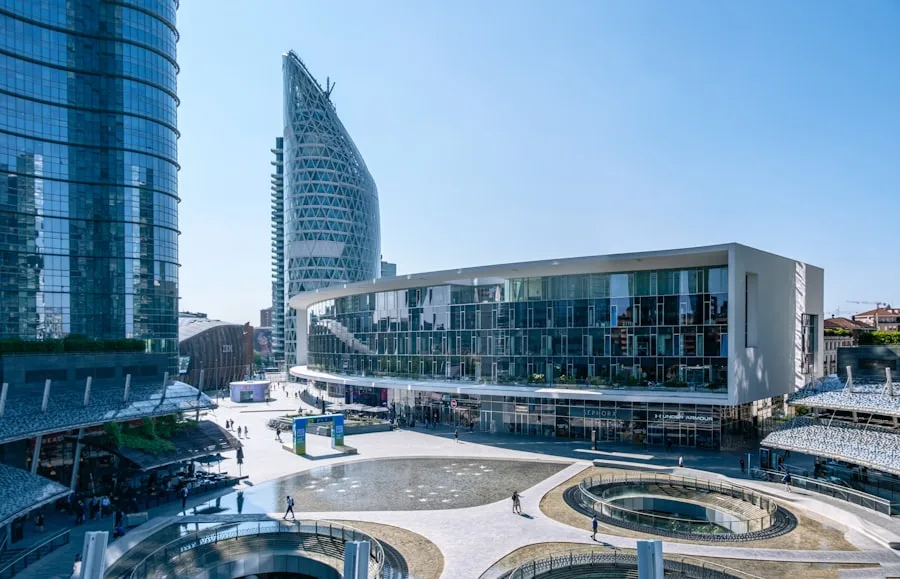
Milano's signature skyline district. The Bosco Verticale, Piazza Gae Aulenti, the Biblioteca degli Alberi park, and the cluster of finance and tech offices that have transformed the city's image internationally.
Porta Nuova as a name predates the skyline by centuries - the original Porta Nuova was one of the medieval gates of Milano, replaced in the eighteenth century by the neoclassical Archi di Porta Nuova still standing on Piazza Cavour. The contemporary Porta Nuova district, however, is the redevelopment that gave Milano its modern skyline: built on the former railway lands between Garibaldi station and the central residential blocks, opened in stages between 2009 and 2018, anchored on the Unicredit Tower (Cesar Pelli, Italy's tallest building for over a decade) and on Stefano Boeri's Bosco Verticale - the vertical forest residential towers with more than 800 trees planted across the façades. The district extends from the Unicredit Tower north to the new Biblioteca degli Alberi (BAM) park.
Who lives here
The most internationally branded resident community in Milano. Senior executives and young professionals at the tower tenants (Unicredit, Microsoft, Amazon, Samsung, HSBC), high-earning international expats, fashion and tech entrepreneurs, the occasional architectural-celebrity owner of a Bosco Verticale apartment. The resident demographic is younger, more international, more corporate and more transient than central Milano's historic neighborhoods. The Bosco Verticale itself houses around 100 apartments across the two towers - a small but high-profile resident community.
What it's like during the day
Polished international business. The morning flow of office workers across Piazza Gae Aulenti, the Saturday-and-Sunday flow of Milanese and tourists coming to photograph the architecture, the children playing in the BAM park, the dogs on the lawns. The pedestrianised plaza around the towers and the curving walkways through the Biblioteca degli Alberi feel more like Singapore or Copenhagen than traditional Milano - a deliberate design choice. Cafés and casual lunch spots on the plaza itself, the Eataly food hall on Piazza XXV Aprile at the southern edge, the Mercato Centrale Milano sister venue at Centrale ten minutes' walk east.
What it's like in the evening
A polished aperitivo and corporate-dinner district. Rooftop bars at the ME Milan hotel and the Excelsior Gallia, the panoramic Maio at La Rinascente Duomo (a Metro ride south), the Terrazza Aperol at the southern edge of the BAM park. The Corso Como nightlife strip is at the southern edge of the district. Less party-driven than Corso Como itself, more after-work-cocktail. The BAM park stays open late and is a Milanese institution for summer evening strolls. The streets between the towers quiet down by midnight.
Getting around
One of the best-connected nodes in Milano. The M2 green and M5 lilac metro interchange at Garibaldi FS is at the heart of the district. The Passante Ferroviario at Garibaldi connects to Malpensa airport and the regional rail network. Tram lines 2, 10 and 33 cover the surface. The new pedestrianised paths through the Biblioteca degli Alberi park make walking north to Isola or south toward Brera comfortable. The Repubblica M3 yellow stop is at the eastern edge. Cycling is encouraged with dedicated lanes throughout the district.
Eating and shopping
The food scene reflects the district's international tilt. Ratanà (one Michelin star) inside the BAM park, Pisacco and various modern Italian and international restaurants on Via Pasubio, the Eataly flagship at Piazza XXV Aprile, the Mercato Centrale Milano inside the Stazione Centrale (food hall), the various hotel restaurants. For groceries, Esselunga inside Piazza Gae Aulenti, Esselunga on Viale Sturzo, Carrefour Market on Via Pasubio, and the food hall at Eataly. The luxury shopping is at the Galleria delle Carrozze inside Centrale and at the small high-end boutiques on Corso Como; mainstream shopping at Corso Buenos Aires fifteen minutes east.
When NOT to pick it
If you want historic Milano, neighborhood texture, affordability, or quiet. Porta Nuova is the most expensive new-build residential district in Italy, the architectural language is firmly contemporary, the resident community is transient enough that you may not know your neighbours, and the constant tourist photography around the Bosco Verticale and Piazza Gae Aulenti can feel intrusive at street level. Construction continues on the periphery (the new towers north of the BAM park) - noise has been periodic. The condominio fees in the new-build towers are high.
Porta Nuova works particularly well for senior executives at the resident tenants, for international expats on three-year corporate assignments, for couples in their thirties or forties without strong attachment to historic Milano, and for the architecture or design professional who wants to live inside the city's most internationally legible district. For families wanting neighborhood schools, traditional Milanese texture and a more settled community, Porta Vittoria or Sant'Ambrogio are calmer; for similar centrality at lower rent with stronger neighborhood feel, Isola is the natural step north.